
Open 24/7 412-765-3345
Open 24/7 412-765-3345
When your property is damaged, you expect your insurance company to honor your policy and provide fair payment for repairs or replacement. Unfortunately, many Pennsylvania property owners discover that getting full payment for their claims is difficult. At SMT Legal, our first-party property damage lawyers understand the frustration and stress that come with these claims, and we work tirelessly to help our clients receive compensation under their insurance policies.
A first-party property damage claim occurs when you seek compensation directly from your own insurance company for damage to your property. Whether your home suffered storm damage, your business experienced a fire, or your property endured other covered losses, you have the right to receive fair payment under the terms of your policy. Our attorneys can help you file successful claims in these situations and more. Call us today at (412) 765-3345 or contact us online for a consultation with an experienced Pennsylvania property damage attorney.
From multi million-dollar injury settlements to complex criminal defense—get the team that fights to win.
Contact Now 412-765-3345
When you file a first-party property damage claim, you act as the policyholder seeking payment from your insurance provider. These claims differ from third-party claims, where you would seek compensation from someone else’s insurance company. Many property owners choose to handle these claims on their own, believing their insurance company will treat them fairly. However, insurance companies often attempt to minimize payouts or deny valid claims altogether.
Common property insurance policies that may lead to first-party claims include:
Even with clear documentation and legitimate damage, insurance companies may attempt to undervalue your claim, delay payment, or dispute the extent of coverage. At SMT Legal, we understand Pennsylvania insurance laws and the tactics insurance companies use to avoid paying full compensation. Our experienced attorneys work to protect your rights and help you receive the full value of your claim under your policy.
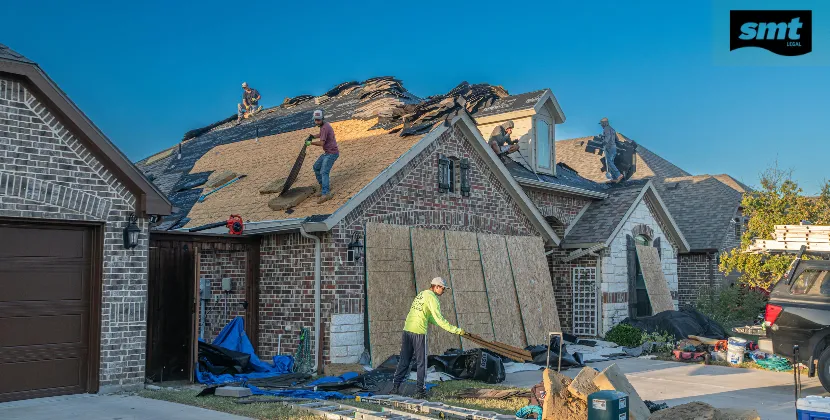
Pennsylvania property owners face unique challenges due to our state’s diverse weather patterns and aging infrastructure. Our legal team at SMT Legal handles many types of first-party property damage claims, including:
Pennsylvania’s aging plumbing systems and heavy rainfall can lead to significant water damage in homes and businesses. Incidents can occur due to damage from burst pipes, roof leaks, basement flooding, and sewer backups. Many insurance companies try to deny these claims by arguing the damage resulted from long-term maintenance issues rather than sudden events.
Our state experiences severe weather throughout the year, from summer thunderstorms to winter nor’easters. Storm damage often affects roofs, siding, windows, and outdoor structures. Even when policies clearly cover wind and hail damage, insurance companies frequently dispute the extent of the damage or attempt to attribute it to pre-existing conditions.
House and business fires can devastate property and possessions. While most insurance policies cover fire damage, disputes often arise over smoke damage, water damage from firefighting efforts, and the actual cost of repairs or replacement. Insurance companies may also question the cause of the fire, potentially leading to claim denials.
Pennsylvania winters bring unique challenges, including ice dams, collapsed roofs from snow accumulation, and frozen pipe damage. Insurance companies often claim these issues stem from poor maintenance rather than weather events, making it crucial to have experienced legal representation.
When vehicles strike buildings, fences, or other structures on your property, your property insurance policy should cover the damage. While the driver’s auto insurance may eventually pay through subrogation, you need your own insurance company to handle repairs promptly.
Property crimes affect many Pennsylvania communities. While most policies cover theft and vandalism, insurance companies frequently dispute the value of stolen or damaged items. They may also question the legitimacy of claims or argue about security measures that were in place.
Filing a first-party property damage claim requires attention to detail and proper documentation. At SMT Legal, we recommend taking these essential steps:
Insurance companies often request extensive documentation, multiple inspections, or recorded statements. They may delay processing your claim or make unreasonably low settlement offers. Having experienced legal representation helps ensure you meet all requirements while protecting your rights to full compensation.
First-party property damage laws and policy terms give insurers several tools for testing a claim. Three of them matter most:
Each comes with rules and deadlines, and a misstep can cost you part of your recovery on a covered loss.
An examination under oath (EUO) is formal questioning, usually by the insurer’s lawyer, with every answer recorded. Many property policies allow the insurer to require one, and insurers use them to test the cause of a loss or the records behind a claim.
Pennsylvania law protects policyholders to an extent. A federal court applying Pennsylvania law held in Ania v. Allstate Insurance that a failure to cooperate can relieve an insurer of liability only if it is substantial and harms the insurer.
A first-party property damage lawyer can review the request, prepare you for the questions, and make sure your answers match your documents. That preparation helps keep a mistake from becoming an accusation that you misstated your loss.
An appraisal clause gives you and the insurer a way to settle a disagreement over the dollar amount of a covered loss without legal action. Appraisal decides how much the loss is worth. It does not decide whether the policy covers it.
In one homeowners clause, the Pennsylvania Superior Court reviewed in Riley v. Farmers Fire Insurance Co., the process works like this:
Policy language varies, so you should read your clause closely. In Allegheny County, a request for an umpire would typically go to the Court of Common Pleas. Appraisal can move a stalled claim forward, but judicial review of an award is limited, so we can review the clause and the estimates before you agree to it.
A sworn statement in proof of loss is a signed, sworn account of what you lost and what it’s worth. Many policies set a deadline for it, such as 60 days from the loss or from the insurer’s request, so be sure to check yours when you file your claim.
A complete proof of loss usually includes these financial details:
Pennsylvania courts ask for substantial compliance, not perfection, and an insurer that relies on a policy condition must show the lapse harmed it. Even so, a late or incomplete filing can delay payment or lead to a denial that you then have to dispute.
If you need more time to file, you can ask the insurer for an extension in writing, since some policies allow one.
Once the insurer has a properly executed proof of loss, 31 Pa. Code § 146.7 requires it to accept or deny the claim within 15 working days, with written updates if it needs more time to investigate.
A separate deadline matters just as much. Many Pennsylvania policies require filing within 1 year of the loss, and the Superior Court enforced that clause in Dutton v. Foremost Insurance Co.
Your policy pays a damaged item’s value in one of two ways. Replacement cost value (RCV) is what it takes to repair or replace damage with materials of similar kind and quality, without a deduction for depreciation. Actual cash value (ACV) is the replacement cost minus depreciation for age and wear and tear.
Insurers estimate depreciation from an item’s age and wear and tear. If a roof is halfway through its useful life and costs $12,000 to replace, under an ACV policy, the insurer could deduct half of that cost, leaving $6,000 before your deductible, the amount you pay first.
The Pennsylvania Insurance Department warns that an ACV policy often does not pay enough to return your home to its condition before the loss.
Many replacement cost policies pay in two steps. The first check covers actual cash value, and the held-back depreciation follows after you finish repairs and show the insurer what you spent. The policy may cap replacement cost at the necessary amount spent to repair or replace.
To claim the balance, you may need to follow these steps:
Matching disputes arise when a repair leaves new materials that don’t blend with the old, such as new shingles next to faded ones or a patch of fresh hardwood in an older floor. The question is whether the insurer must pay to replace the surrounding area so it looks uniform.
Some states set matching rules by regulation, and some apply a line of sight test that asks whether damaged and undamaged areas are visible together. Pennsylvania disputes usually depend on the policy’s wording and the facts, and courts have reached different results. We can compare your policy language with the repair estimate before you accept a partial repair.
Pennsylvania’s Modified Coverage Form for older homes, Form 8, pays functional replacement cost, which allows materials commonly available today to replace older ones that are no longer made.
Our experienced property damage attorneys at SMT Legal understand the complexities of insurance policies and Pennsylvania property laws. We help our clients by:
Our attorneys are more than familiar with going up against insurance companies on behalf of Pennsylvania property owners. We understand the tactics they use to minimize claims, and we know how to counter their arguments effectively.
At SMT Legal, we handle property damage claims on a contingency fee basis, which means you pay no legal fees unless we recover compensation for you. We advance all costs necessary to properly document and support your claim.
You should hire a first-party property damage lawyer when your insurer requests an EUO, disputes the amount of your loss, or offers less than your repair estimates. At SMT Legal, we can read your policy, track its deadlines, and handle the insurer’s requests while you focus on repairs.
We can explain how Pennsylvania’s first-party property damage laws apply to your policy, including any one-year deadline to take legal action.
Our Pittsburgh office is at 114 Smithfield Street. Bring us the insurer’s letter, and a first-party property damage attorney can explain what it requires and when it’s due during a free consultation.
How much a first-party property damage lawyer costs depends on case specifics and the fee agreement. When a lawyer takes a case for a percentage of the recovery, Pennsylvania’s Rules of Professional Conduct require a written agreement that states the percentage and how expenses are handled.
You should hire a lawyer even if your insurer sends an adjuster because you should have someone on your side. The insurer’s adjuster assesses the damage and gives the insurance company documentation that helps determine your settlement. A lawyer works for you, so we can question that assessment before you accept an offer.
You can potentially recover up to your policy limits for property damage, after the deductible. Other structures, such as a detached garage, are typically limited to 10% of the dwelling limit, and loss of use to 20%. If a court finds your insurer acted in bad faith, 42 Pa.C.S. § 8371 allows interest, punitive damages meant to punish the insurer, and attorney fees. Bad faith requires clear and convincing proof, a high standard.
To settle a first-party property damage claim, start by finding out the full cost of repairs before you meet with the adjuster. Send your documents, ask for the insurer’s valuation in writing, and negotiate any gap. If you disagree, check your policy for an appraisal clause or talk to one of our lawyers. You can also file a complaint with the Insurance Department, which handled nearly 17,000 consumer complaints in one year.
A homeowners policy in Pittsburgh doesn’t usually cover mine subsidence or flood damage. A typical homeowners policy doesn’t cover flood, and the Department of Environmental Protection says mine subsidence is usually not covered either.
Flood needs a separate policy, and mine subsidence has its own state-run insurance. DEP estimates that more than 1 million Pennsylvania structures are at risk from mine subsidence, and only about 6% of them are insured.
Your insurer cannot cancel your policy just for filing a claim. Pennsylvania law doesn’t let an insurer terminate a homeowners policy because of claims or loss history. Other reasons, such as an unpaid premium or an unrepaired hazard, can still lead to cancellation, and claims can affect your premium.
This Changes Everything. We’re Ready Anyway.

In the aftermath of property damage, you need robust legal representation to ensure your insurance company treats you fairly. At SMT Legal, we fight for Western and Central Pennsylvania property owners to receive the full compensation they deserve under their insurance policies. Our experienced attorneys understand the stress and disruption that property damage causes, and we work to resolve your claim as quickly as possible while maximizing your recovery.
Contact SMT Legal today at (412) 765-3345 for a free consultation about your property damage claim. Let us put our experience and resources to work for you while you focus on restoring your property and moving forward with your life.












A low first offer after a crash is hard to weigh while you are still recovering. How to…
Damage to your car or home leaves you with repairs to arrange, bills to cover, and a claim…

Is a DUI a felony in Pennsylvania? This is what many who are charged with DUI may wonder…

When you bring your child to a daycare facility, you do so with the assumption that they should…

Few things are more devastating than having your life turned upside down by a fire caused by gas…

If a police officer pulls you over on suspicion of impaired driving, taking a breathalyzer test might not…

If you’ve been arrested or charged with driving under the influence, you’re probably already asking: Can a DUI…
If you’ve suffered an injury due to a defective product you have purchased or used, you may be…
call us today (412) 765-3345
Fields marked with an * are required
"*" indicates required fields
© 2026 SMT LEGAL• All Rights Reserved. Disclaimer | Site Map | Privacy Policy. Digital Marketing By: 
*Images are obtained under license from Canva and other third-party stock image providers, with attribution included where required.
